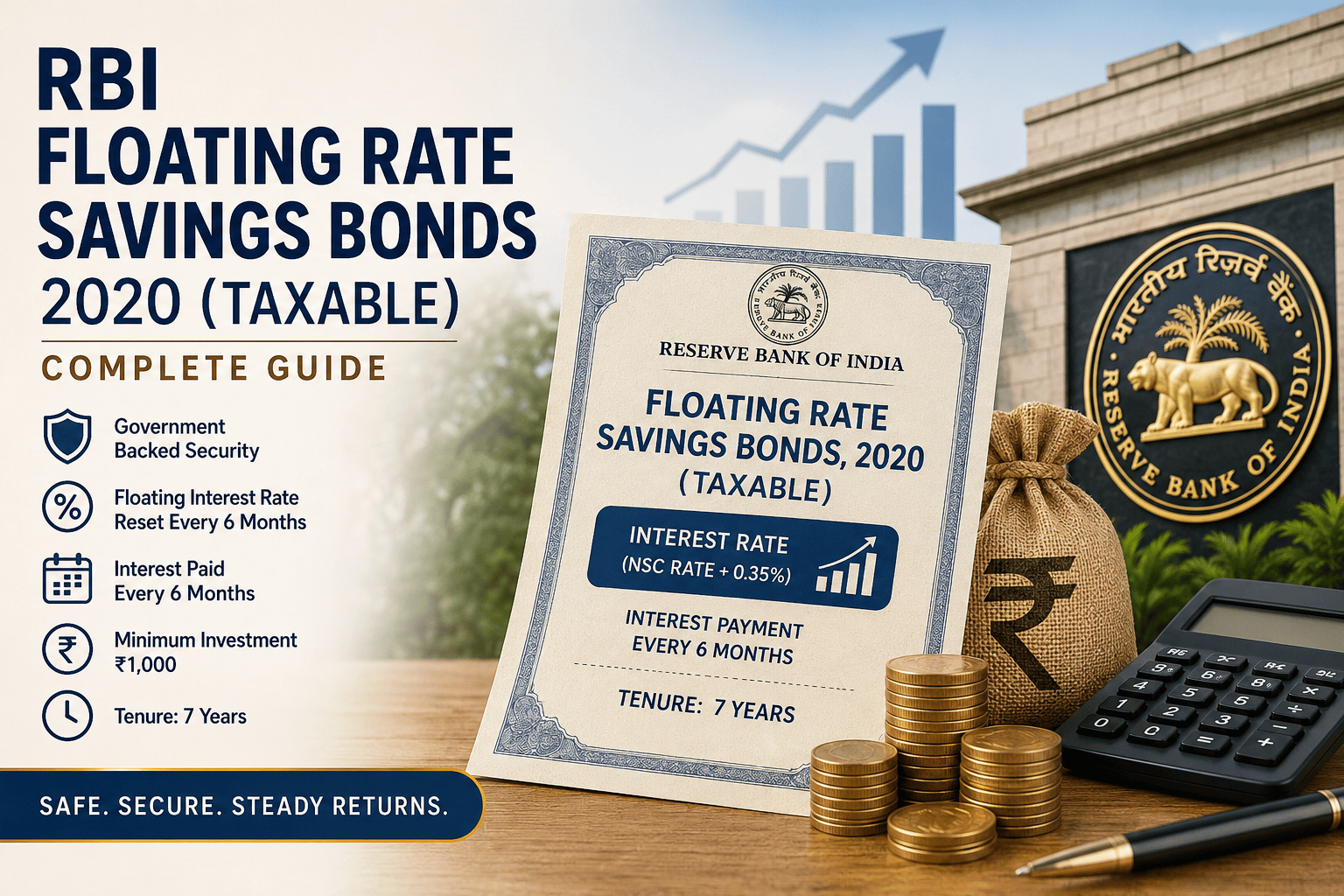

Investing your money safely while earning stable returns is a priority for many investors, especially those who prefer government-backed investment options over market-linked products. The RBI Floating Rate Savings Bonds, 2020 (Taxable) are one such investment avenue introduced by the Government of India and managed by the Reserve Bank of India (RBI).
Unlike traditional Fixed Deposits (FDs), these bonds offer a floating interest rate, meaning the interest is revised periodically instead of remaining fixed throughout the investment tenure. Since the bonds are backed by the Government of India, they carry virtually no credit risk, making them one of the safest fixed-income investment options available to individual investors.
Whether you are a conservative investor, a retiree seeking regular income, or someone looking to diversify your investment portfolio with government securities, understanding how these bonds work is essential before investing.
In this guide, you’ll learn everything about RBI Floating Rate Savings Bonds, including their features, eligibility, interest rate, investment limits, maturity, premature withdrawal rules, taxation, advantages, disadvantages, and how they compare with Fixed Deposits and other government savings schemes.
| Particular | Details |
|---|---|
| Scheme Name | RBI Floating Rate Savings Bonds, 2020 (Taxable) |
| Issuer | Government of India |
| Managed By | Reserve Bank of India (RBI) |
| Type | Government Savings Bond |
| Interest Rate | Floating (Linked with NSC Rate + 0.35%) |
| Interest Reset | Every 6 Months |
| Interest Payment | Semi-Annually (1 January & 1 July) |
| Current Interest Rate | 8.05% (As notified by RBI for the applicable period) |
| Minimum Investment | ₹1,000 |
| Maximum Investment | No Limit |
| Investment Multiples | ₹1,000 |
| Tenure | 7 Years |
| Lock-in Period | 7 Years (except eligible senior citizens) |
| Premature Withdrawal | Available only for eligible senior citizens under specified conditions |
| Risk Level | Very Low |
| Capital Protection | 100% Government Backed |
| Tax Benefit | No |
| Taxation | Interest is fully taxable |
| TDS | Applicable as per Income Tax Rules |
| Demat Account Required | No |
| Nomination Facility | Available |
| Transferable | No |
| Tradable | No |
| Loan Facility | Not Available |
What are RBI Floating Rate Savings Bonds?
The RBI Floating Rate Savings Bonds, 2020 (Taxable) are government-backed savings instruments issued by the Government of India under the Reserve Bank of India’s operational framework. These bonds were introduced to provide investors with a secure investment option that offers periodic income through interest payments while protecting the invested capital.
Unlike conventional Fixed Deposits or fixed-rate government bonds, the interest rate on these bonds is not fixed for the entire investment period. Instead, it is reviewed and reset every six months based on the prevailing National Savings Certificate (NSC) interest rate, with an additional spread of 0.35%.
This floating-rate mechanism allows investors to benefit if government savings rates increase over time. However, if the benchmark rate decreases, the bond’s interest rate is also adjusted downward during the next reset period.
These bonds have a fixed tenure of seven years and pay interest every six months directly to the investor. Since the bonds are backed by the Government of India, the repayment of both principal and interest is considered highly secure.
Unlike many market-linked investments, RBI Floating Rate Savings Bonds are non-transferable, non-tradable, and cannot be pledged as collateral, making them suitable primarily for investors seeking long-term, stable income rather than liquidity.
Key Highlights
- Issued by the Government of India.
- Administered by the Reserve Bank of India.
- 100% government-backed investment.
- Floating interest rate linked to the NSC interest rate.
- Interest is paid every six months.
- Seven-year investment tenure.
- No upper limit on investment amount.
- Suitable for conservative and income-focused investors.
Eligibility for RBI Floating Rate Savings Bonds
Not everyone can invest in RBI Floating Rate Savings Bonds. The Government has specified who is eligible under the scheme.
You can invest if you are:
- An individual resident in India.
- A Hindu Undivided Family (HUF).
- A minor through a parent or legal guardian.
- Joint holders (up to two holders).
- Eligible charitable institutions or universities as permitted under the scheme.
Who Cannot Invest?
The following are not eligible:
- Non-Resident Indians (NRIs).
- Overseas Citizens of India (OCIs), unless otherwise permitted under FEMA regulations.
- Foreign institutional investors.
- Companies and partnership firms (unless specifically covered under the operational guidelines).
Note: If a resident investor later becomes an NRI after purchasing the bond, the investment may continue until maturity as per applicable regulations, subject to RBI guidelines.
Investment Amount (Deposit)
One of the biggest advantages of RBI Floating Rate Savings Bonds is that there is no maximum investment limit. Investors can invest according to their financial goals.
Minimum Investment
The minimum investment amount is:
₹1,000
Investment Multiples
Additional investments must be made in multiples of:
₹1,000
Examples:
| Investment | Allowed |
|---|---|
| ₹1,000 | ✅ |
| ₹5,000 | ✅ |
| ₹25,000 | ✅ |
| ₹1,00,000 | ✅ |
| ₹10,00,000 | ✅ |
| ₹50,00,000 | ✅ |
Maximum Investment
There is no upper limit on the investment amount.
This makes the scheme suitable for:
- Retired individuals
- High-net-worth investors
- Individuals looking to park surplus funds safely
- Investors seeking government-backed fixed-income investments
Interest Rate of RBI Floating Rate Savings Bonds
The most distinctive feature of this scheme is its floating interest rate.
Unlike a Fixed Deposit, where the interest remains unchanged throughout the tenure, the interest rate on these bonds changes every six months.
The interest rate is linked to the National Savings Certificate (NSC) interest rate with an additional spread of 0.35% per annum.
For example:
- If the NSC interest rate is 7.70%, the bond interest rate becomes:
7.70% + 0.35% = 8.05% per annum
This rate remains applicable for the next six months and is revised again on the next reset date.
Interest Rate Reset Dates
The rate is reviewed twice every year:
- 1 January
- 1 July
The revised rate applies for the following six months.
How is the Interest Rate Determined?
The formula is:
Floating Rate = Prevailing NSC Interest Rate + 0.35%
This means:
- If NSC rates increase, the bond’s interest rate also increases.
- If NSC rates decrease, the bond’s interest rate decreases accordingly.
This feature allows investors to benefit from rising government savings rates while accepting the possibility of lower returns if benchmark rates fall.
Interest Payment
Unlike cumulative investment products where interest is reinvested, RBI Floating Rate Savings Bonds pay interest directly to investors every six months.
Payment Frequency
Interest is paid:
- 1 January
- 1 July
every year until maturity.
The interest amount is credited directly to the investor’s registered bank account.
Example
Suppose you invest:
₹10,00,000
If the applicable interest rate for that six-month period is 8.05% per annum, then:
Annual Interest:
₹10,00,000 × 8.05% = ₹80,500
Since interest is paid twice a year:
Every six months, you receive:
₹80,500 ÷ 2 = ₹40,250
If the interest rate changes during the next reset period, the subsequent interest payment will be calculated using the revised rate.
Important Points
- Interest is not compounded.
- Interest is not reinvested automatically.
- Investors receive regular cash flow every six months.
- The principal amount remains unchanged until maturity.
Taxation of RBI Floating Rate Savings Bonds, 2020 (Taxable)
As the name suggests, RBI Floating Rate Savings Bonds, 2020 (Taxable) do not offer any tax exemption on the interest earned. Investors should understand the tax implications before investing, especially if they fall into a higher income tax slab.
Is the Interest Taxable?
Yes. The interest earned on RBI Floating Rate Savings Bonds is fully taxable under the head ‘Income from Other Sources’ as per the Income Tax Act, 1961.
The applicable tax depends on the investor’s income tax slab.
For example:
| Tax Slab | Interest Tax Treatment |
|---|---|
| 5% | Interest taxed at 5% |
| 20% | Interest taxed at 20% |
| 30% | Interest taxed at 30% |
The higher your tax slab, the lower your effective post-tax return.
Is TDS Applicable?
Yes. Tax Deducted at Source (TDS) may be deducted on interest payments as per the provisions of the Income Tax Act if the applicable threshold and conditions are met.
If your total taxable income is below the prescribed limit and you are eligible under the Income Tax Rules, you may submit the applicable declaration form (such as Form 15G or Form 15H, where eligible) to avoid TDS.
Note: Deduction of TDS does not mean the interest becomes tax-free. The entire interest remains taxable according to your applicable income tax slab.
Is There Any Tax Deduction Under Section 80C?
No.
Investment in RBI Floating Rate Savings Bonds does not qualify for deduction under Section 80C of the Income Tax Act.
Unlike schemes such as the Public Provident Fund (PPF), National Savings Certificate (NSC), or eligible tax-saving Fixed Deposits, these bonds do not provide any tax-saving benefit on the amount invested.
Taxation Summary
| Particular | Tax Treatment |
|---|---|
| Tax Benefit on Investment | Not Available |
| Interest Income | Fully Taxable |
| TDS | Applicable as per Income Tax Rules |
| Section 80C Benefit | No |
| Capital Repayment at Maturity | Not Taxable (Principal Returned) |
Maturity of RBI Floating Rate Savings Bonds
The maturity period of RBI Floating Rate Savings Bonds is 7 years from the date of investment.
During these seven years:
- The investor continues to receive interest every six months.
- The principal amount remains invested throughout the tenure.
- No repayment of principal is made before maturity unless premature redemption is permitted under the scheme.
What Happens at Maturity?
On completion of the seven-year tenure:
- The entire principal amount is repaid.
- The last semi-annual interest payment is also credited.
- The bond is automatically redeemed.
- No renewal takes place.
For example:
Suppose you invested ₹5,00,000.
After completing seven years:
- Principal Returned = ₹5,00,000
- Final six-month interest = Paid separately
- Bond Status = Closed
If you wish to continue investing, you’ll need to purchase fresh bonds, subject to the scheme being available at that time.
Premature Closure (Premature Redemption)
One of the most important limitations of RBI Floating Rate Savings Bonds is their restricted liquidity.
Unlike Fixed Deposits, these bonds generally cannot be redeemed before maturity.
However, an exception has been made for senior citizens.
Premature Redemption for Senior Citizens
| Age of Investor | Premature Redemption Allowed After |
|---|---|
| Below 60 Years | Not Allowed |
| 60–70 Years | After 6 Years |
| 70–80 Years | After 5 Years |
| 80 Years & Above | After 4 Years |
The age of the investor is considered on the date of investment.
Interest Penalty
When eligible investors opt for premature redemption, the RBI guidelines provide for a penalty on the last interest payment, as specified under the scheme.
Investors should refer to the latest operational guidelines or their receiving bank for the exact calculation applicable at the time of redemption.
Can You Sell the Bond?
No.
These bonds are:
- Non-transferable
- Non-tradable
- Not listed on any stock exchange
Therefore, investors cannot sell them in the secondary market before maturity.
Nomination Facility
The scheme offers a nomination facility, allowing investors to nominate one or more individuals who can claim the investment in the event of the bondholder’s death.
Nomination helps ensure a smooth transfer of the investment without unnecessary legal complications.
Who Can Be Nominated?
The nominee can be:
- A family member
- Spouse
- Child
- Parent
- Any other individual chosen by the investor
Can Nomination Be Changed?
Yes.
The investor may:
- Add a nominee
- Change an existing nominee
- Cancel a nomination
at any time during the bond tenure by following the prescribed procedure through the receiving bank.
What Happens After the Investor’s Death?
In the unfortunate event of the investor’s death:
- The nominee or legal heir can submit the required documents to the receiving bank.
- The claim is processed according to the applicable RBI guidelines.
- The outstanding principal and eligible interest are paid to the rightful claimant.
How to Invest in RBI Floating Rate Savings Bonds
Investors can purchase RBI Floating Rate Savings Bonds through authorised receiving offices notified by the Government of India.
Offline Investment
Visit an authorised bank branch and:
- Fill out the application form.
- Complete the KYC process.
- Submit PAN and other required documents.
- Mention nominee details.
- Deposit the investment amount.
- Receive the Certificate of Holding after successful processing.
Online Investment
Several authorised banks also allow eligible customers to invest through Internet Banking.
The general process includes:
- Log in to your Net Banking account.
- Navigate to the Government Securities or Investment section.
- Select RBI Floating Rate Savings Bonds.
- Enter the investment amount.
- Confirm nominee details.
- Complete the transaction.
Documents Required
Typically, investors need:
- PAN Card
- Aadhaar or other valid KYC proof
- Bank Account Details
- Passport-size Photograph (if required)
- Duly filled application form
Certificate of Holding
After the investment is processed, investors receive a Certificate of Holding, which serves as proof of ownership.
The certificate contains details such as:
- Investor Name
- Bond Amount
- Date of Investment
- Maturity Date
- Bond Reference Number
Advantages of RBI Floating Rate Savings Bonds, 2020 (Taxable)
RBI Floating Rate Savings Bonds offer several benefits for investors looking for a secure, long-term investment with regular income. Since these bonds are backed by the Government of India, they are considered one of the safest fixed-income investment options available.
1. Government-Backed Security
The bonds are issued by the Government of India, making them one of the safest investment options. Both the principal amount and interest payments are backed by the sovereign, significantly reducing the risk of default.
2. Floating Interest Rate
Unlike traditional Fixed Deposits, the interest rate is reviewed every six months. As the interest rate is linked to the National Savings Certificate (NSC) rate plus a fixed spread, investors may benefit if government savings rates increase in the future.
3. Regular Semi-Annual Income
Interest is paid every six months, providing a predictable source of income. This makes the scheme particularly suitable for retirees and income-focused investors.
4. No Maximum Investment Limit
There is no upper limit on the investment amount, allowing individuals to invest according to their financial goals.
5. Low Credit Risk
Since the issuer is the Government of India, investors do not have to worry about corporate default or credit risk.
6. Easy Investment Process
The bonds can be purchased through authorised banks, and many banks also offer online investment facilities through Internet Banking.
7. Simple Investment Product
There are no market fluctuations, NAV calculations, or complex pricing mechanisms. Investors know exactly how the scheme works and receive periodic interest payments.
Disadvantages of RBI Floating Rate Savings Bonds
Despite their safety, these bonds have certain drawbacks that investors should consider before investing.
1. Seven-Year Lock-in Period
The investment remains locked in for seven years, except for eligible senior citizens who may redeem the bonds earlier under specified conditions.
2. Interest is Fully Taxable
The interest earned is added to the investor’s taxable income and taxed according to the applicable income tax slab.
3. No Tax Benefit
Unlike PPF, ELSS, NSC, or tax-saving Fixed Deposits, these bonds do not provide any deduction under Section 80C of the Income Tax Act.
4. Interest Rate Can Decrease
Although the floating rate can increase, it may also decrease if the benchmark NSC interest rate is reduced by the Government.
5. Limited Liquidity
The bonds cannot be sold in the secondary market and cannot generally be redeemed before maturity.
6. No Compounding Benefit
Interest is paid out every six months instead of being reinvested. Investors looking for compounded returns may prefer cumulative investment options.
Limitations of RBI Floating Rate Savings Bonds
Before investing, it’s important to understand the scheme’s limitations.
- The bonds are non-transferable.
- They cannot be traded on stock exchanges.
- Loans cannot be obtained against these bonds.
- They are not suitable for short-term financial goals.
- There is no option for cumulative interest.
- No tax-saving benefits are available.
- Premature redemption is restricted for most investors.
- The interest rate is uncertain because it changes every six months.
These limitations make the scheme more suitable for long-term, conservative investors than those seeking liquidity or tax efficiency.
RBI Floating Rate Savings Bonds vs Other Investment Options
| Feature | RBI Floating Rate Savings Bonds | Bank Fixed Deposit | Senior Citizens Savings Scheme (SCSS) | National Savings Certificate (NSC) | Post Office Monthly Income Scheme (POMIS) |
|---|---|---|---|---|---|
| Issuer | Government of India | Scheduled Banks | Government of India | Government of India | Government of India |
| Safety | Very High | High | Very High | Very High | Very High |
| Interest Type | Floating | Fixed | Fixed | Fixed | Fixed |
| Interest Payment | Every 6 Months | Monthly / Quarterly / At Maturity | Quarterly | At Maturity | Monthly |
| Interest Rate Revision | Every 6 Months | No | For new investments only | Fixed at investment | Fixed at investment |
| Investment Tenure | 7 Years | 7 Days–10 Years | 5 Years | 5 Years | 5 Years |
| Maximum Investment | No Limit | Depends on Bank | Government-prescribed limit | No Limit | Government-prescribed limit |
| Tax Benefit | No | Only Tax Saver FD | No | Yes (Section 80C) | No |
| Premature Withdrawal | Restricted | Allowed with penalty | Allowed with conditions | Restricted | Allowed with conditions |
| Market Risk | None | None | None | None | None |
| Best For | Long-term regular income | Flexible savings | Senior citizens | Tax-saving investors | Monthly income seekers |
Who Should Invest in RBI Floating Rate Savings Bonds?
These bonds are suitable for investors who prioritize capital safety over high returns.
You may consider investing if you are:
- A conservative investor.
- Looking for a government-backed investment.
- Seeking regular income every six months.
- Planning long-term investments.
- A retiree looking for stable cash flow.
- Diversifying your fixed-income portfolio.
Who Should Avoid Investing?
The scheme may not be suitable for everyone.
You may want to consider other investment options if you:
- Need easy access to your money.
- Prefer high-growth investments.
- Want tax-saving benefits.
- Are building long-term wealth through equity investments.
- Prefer cumulative interest instead of regular payouts.
- Expect to require funds before seven years.
Conclusion
The RBI Floating Rate Savings Bonds, 2020 (Taxable) are an excellent choice for investors seeking safety, regular income, and government-backed security. The floating interest rate provides the potential to benefit from future increases in government savings rates while maintaining the assurance of sovereign backing.
However, these bonds are not designed for investors seeking liquidity, tax benefits, or high capital appreciation. The seven-year tenure, taxable interest, and limited exit options make them better suited for individuals with long-term financial goals.
Before investing, evaluate your liquidity needs, tax bracket, and income requirements. If your primary objective is preserving capital while earning periodic income from a low-risk investment, RBI Floating Rate Savings Bonds can be a valuable addition to your portfolio.
Frequently Asked Questions (FAQs)
1. What are RBI Floating Rate Savings Bonds?
They are government-backed savings bonds that offer a floating interest rate linked to the National Savings Certificate (NSC) rate plus a fixed spread.
2. Who can invest in RBI Floating Rate Savings Bonds?
Resident individuals, Hindu Undivided Families (HUFs), minors through guardians, and certain eligible institutions can invest.
3. What is the minimum investment amount?
The minimum investment amount is ₹1,000, with additional investments allowed in multiples of ₹1,000.
4. Is there any maximum investment limit?
No. There is no upper limit on the investment amount.
5. How is the interest rate determined?
The interest rate is linked to the prevailing NSC interest rate plus 0.35%, and it is reviewed every six months.
6. When is the interest paid?
Interest is paid twice a year, on 1 January and 1 July.
7. Is the interest taxable?
Yes. The interest earned is fully taxable according to the investor’s applicable income tax slab.
8. Do these bonds offer any tax benefits?
No. Investments in these bonds are not eligible for deduction under Section 80C.
9. Can I withdraw my money before maturity?
Generally, no. Premature redemption is permitted only for eligible senior citizens under the conditions specified in the scheme.
10. What is the maturity period?
The bonds mature after 7 years from the date of investment.
11. Can these bonds be transferred to another person?
No. The bonds are non-transferable.
12. Can they be traded on the stock exchange?
No. RBI Floating Rate Savings Bonds are not listed or traded on any stock exchange.
13. Can I get a loan against these bonds?
No. Loans against these bonds are not permitted.
14. Is a Demat account required?
No. A Demat account is not required to invest in these bonds.
15. Are RBI Floating Rate Savings Bonds better than Fixed Deposits?
It depends on your investment goals. These bonds offer sovereign backing and a floating interest rate, while Fixed Deposits provide greater flexibility and easier premature withdrawal.